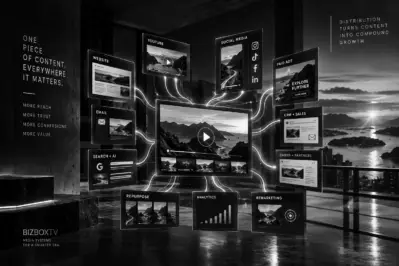
Before media systems were a strategy, they were simply how newsrooms operated.
Before founding BizBOXTV, Lisa Ostrikoff worked in TV broadcast journalism – where winning attention fast and owning visibility wasn’t optional, it was survival.
Stories were not produced occasionally.
They were produced continuously.
Every day the newsroom generated new information.
Stories were written.
Video was produced.
Distribution happened across channels.
And something interesting became obvious.
Visibility did not come from one story.
It came from the system producing stories.
When a newsroom published consistently, audiences returned.
Familiarity grew.
The organization became part of the daily information environment.
But when publishing slowed, attention moved elsewhere.
The system reset.
Years later, watching how businesses approached marketing, the same pattern appeared.
Most companies treated media like campaigns.
An announcement.
A promotion.
A short burst of activity.
Then silence.
From a newsroom perspective, this approach felt strange.
Because attention does not behave like a campaign.
It behaves like a stream.
Audiences do not return because of one piece of content.
They return because signal appears consistently.
The organizations dominating attention online today operate much closer to media organizations than traditional marketing departments.
They produce continuously.
They distribute across platforms.
They learn from what audiences respond to.
In other words, they operate systems.
What legacy newsrooms understood intuitively for decades is now becoming true for businesses as well.
Visibility is not created by occasional messages.
It is created by organizations capable of producing and distributing media continuously.
The difference is not simply content.
It is the system behind it.
And once that system exists, attention behaves very differently.
Instead of appearing briefly and disappearing, it begins to accumulate.
Because the organizations that appear consistently in the environments where audiences spend their time eventually become the ones those audiences recognize first.