Before you create more content, ask whether you have fully distributed what you already own.
There is a familiar response when business content stops generating attention:
We need more content.
More videos.
More posts.
More reels.
More blogs.
More campaigns.
Sometimes that is true.
But after years of working inside business media systems, we see another problem constantly:
The business does not necessarily have a content problem. It has a distribution problem.
Great videos get posted once.
Customer stories disappear into social feeds.
Expensive productions get used for a campaign and forgotten.
Useful articles sit quietly on websites.
Sales teams have no idea what content already exists.
High-performing creative gets replaced because the calendar says it is time to make something new.
The organization keeps producing.
Very little compounds.
PUBLISHING IS NOT DISTRIBUTION
This distinction matters.
Uploading a video to Instagram is publishing.
Putting something on YouTube is publishing.
Adding an article to your website is publishing.
Distribution asks a much bigger question:
How many relevant opportunities have we created for the right audience to encounter this asset?
That might include social media.
But it could also include:
Your website.
YouTube.
Google Search.
AI discovery.
Paid advertising.
Email.
CRM communication.
Sales follow-up.
Landing pages.
Remarketing.
Internal sales tools.
Partner channels.
Short-form derivatives.
Future campaigns.
The asset did not stop being valuable because Tuesday ended.
BUSINESSES ARE CONSTANTLY ABANDONING GOOD MEDIA
This is one of the strangest behaviours in modern marketing.
A company can spend thousands of dollars producing a strong video, publish it several times, and mentally classify it as done.
Meanwhile, most of its potential audience never saw it.
That is because social feeds have conditioned businesses to think chronologically.
New = valuable. Old = finished.
But customers do not experience your content calendar.
Someone discovering your company today does not care that a video was created eight months ago.
They care whether it answers the question they have right now.
A strong customer testimonial does not expire because it was posted last year.
A useful product explanation does not become irrelevant because the Instagram algorithm already saw it.
A great brand story does not lose its value because the campaign ended.
If the information is still relevant, the media can still work.
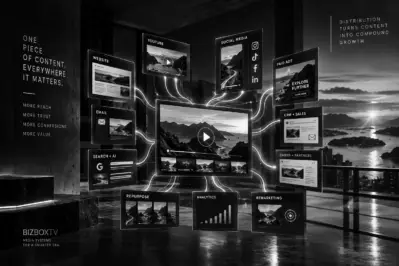
ONE VIDEO SHOULD RARELY BE ONE PIECE OF CONTENT
Consider what can happen after one strong video is produced.
The full version can live on your website.
It can be published to YouTube.
Several shorter clips can be created for social.
A specific section can become paid advertising creative.
Another clip can answer a common customer question.
The transcript can inform an article.
The article can strengthen search visibility.
The video and article can create additional context for AI discovery.
A salesperson can send the most relevant segment directly to a prospect.
A high-performing clip can be amplified through paid media.
Months later, the strongest idea can be resurfaced for an audience that never encountered it the first time.
Now the economics of production change.
You are no longer asking:
What did this video cost?
You start asking:
How much useful media did this production create?
That is a very different equation.
CREATE → DISTRIBUTE → MEASURE → LEARN
This is also why distribution cannot simply be the final step.
It creates intelligence.
When media moves across platforms and audiences, you begin learning.
Which hooks stop attention?
Which subjects generate clicks?
Which videos hold viewers?
Which questions generate engagement?
Which creative produces leads?
Which messages salespeople actually use?
Which topics surface through search?
Which customer problems keep appearing?
Performance becomes feedback.
That feedback should influence what gets produced next.
At BizBOXTV, this is why we think in systems rather than isolated campaigns.
STRATEGY → PRODUCE → DEPLOY → MEASURE → REFINE
The output of one cycle becomes intelligence for the next.
That is how media begins to compound.
YOUR CONTENT LIBRARY IS AN ASSET
Many established businesses are sitting on years of underused media.
Videos.
Photography.
Interviews.
Customer stories.
Product footage.
Articles.
FAQs.
Campaign creative.
Presentations.
Sales material.
Executive commentary.
Raw footage.
The first question should not always be:
What should we create next?
Sometimes the better question is:
What do we already own that is not working hard enough?
Audit it.
Organize it.
Update what needs updating.
Cut it differently.
Repackage it.
Connect it to relevant pages.
Put it into sales workflows.
Optimize it for search.
Build campaigns around it.
Redistribute it to audiences that have never seen it.
Your archive should not be a graveyard.
It should be inventory.
THIS IS WHERE CONTENT BECOMES INFRASTRUCTURE
A business posting content is participating in media.
A business building systems around that content is creating infrastructure.
There is a significant difference.
Infrastructure means the organization knows what media it owns.
It knows where that media belongs.
It knows which audience it serves.
It knows how it moves through channels.
It knows how sales can use it.
It knows what performed.
And it knows what those signals mean for the next piece of media.
The objective is no longer to keep feeding a content calendar.
The objective is to build a growing body of media that continues creating visibility, trust and demand.
MORE CONTENT IS NOT ALWAYS THE ANSWER
There will always be a need for fresh creative.
Markets change.
Products change.
Customers change.
Platforms change.
Businesses change.
But relentless production without intelligent distribution creates an expensive treadmill.
More goes in.
More comes out.
Very little accumulates.
The businesses that build real media leverage will operate differently.
They will create deliberately.
Distribute aggressively.
Measure intelligently.
Repurpose strategically.
And continue extracting value from strong media long after its original publish date.
THE BOTTOM LINE
Your next marketing breakthrough may not require another 100 videos.
It may require getting considerably more value from the 100 you already have.
Create once does not mean post once.
Build the asset.
Distribute it.
Repurpose it.
Deploy it through sales.
Amplify what works.
Learn from the response.
Then let that intelligence determine what deserves to be created next.
Because the goal is not to produce the most content.
The goal is to build media that compounds.