Automotive marketing used to be easier to define.
A dealership advertised inventory. Ran promotions. Bought media. Managed a website. Maybe produced a commercial.
Today, a vehicle shopper can encounter a dealership through Instagram, Facebook, YouTube, Google, AI search, an inventory listing, a review, a video, a retargeting ad or a recommendation… long before they ever submit a lead.
The customer journey changed.
Automotive marketing changed with it.
But inside many dealerships, the structure responsible for managing that journey has not changed nearly enough.
Automotive Marketing Is No Longer a Collection of Campaigns
The traditional campaign model has a beginning and an end.
Launch the offer.
Run the ads.
Generate the leads.
Report the results.
Reset.
That model increasingly conflicts with how people actually shop for vehicles.
Customers move in and out of the market. They research models. Watch videos. Compare inventory. Visit dealership websites. Read reviews. Encounter advertising. Follow social content. Search again.
Some convert quickly.
Others remain invisible for weeks or months before finally raising their hand.
The dealership cannot control when someone enters the market.
It can control whether the dealership is visible when they do.
That changes the job of automotive marketing.
The objective is no longer simply to generate activity during a campaign.
The objective is to maintain market presence continuously.
Dealerships Are Operating Media Networks
Look at the infrastructure surrounding a modern dealership.
Website.
Inventory.
Google.
YouTube.
Facebook.
Instagram.
Video.
Paid advertising.
Email.
CRM.
Reviews.
Search.
Third-party automotive platforms.
Analytics.
Each produces or distributes information that can influence the customer journey.
The problem is that these pieces are often managed independently.
The social person posts.
The advertising vendor runs ads.
The website provider manages the website.
The inventory provider manages inventory.
Someone produces video.
Someone else looks at analytics.
The CRM receives the leads.
Everyone can be doing their job while the customer experiences a fragmented system.
More marketing activity does not automatically create more marketing effectiveness.
Connection matters.
One Person Cannot Be the Media System
There is another structural problem hiding inside many dealership marketing departments.
One internal marketing person may be expected to manage social media, content, video, promotions, vendors, website changes, advertising requests, analytics, inventory merchandising + whatever needs to be posted today.
That person may be extremely capable.
The expectation is still unreasonable.
Modern automotive marketing has become a multidisciplinary media operation.
That is not a staffing problem. It is an infrastructure problem.
A strong internal marketing person becomes considerably more valuable when operating inside a defined system instead of being expected to be the system.
Build the system around the people.
Do not expect the people to become the system.
Video Should Exist Throughout the Customer Journey
Video deserves particular attention because dealerships frequently treat it as content rather than infrastructure.
A walkaround gets posted.
A Reel gets uploaded.
A commercial runs.
Done.
But video can perform completely different jobs throughout the vehicle-shopping journey.
It can create initial attention.
Introduce a vehicle.
Explain a feature.
Answer a question.
Build familiarity with the dealership.
Support search discovery.
Retarget an interested shopper.
Explain an offer.
Humanize a salesperson.
Re-engage an opportunity.
Build confidence before an appointment.
The strategic question should not be:
“What video should we post this week?”
It should be:
“Where can video move the customer forward?”
That is a very different way of operating.
The Automotive Media System
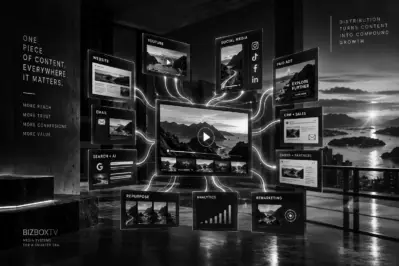
At BizBOXTV, we increasingly look at automotive marketing through three connected layers:
EXECUTION
Continuously create useful media around inventory, vehicles, offers, people, expertise + dealership stories.
DISTRIBUTION
Move that media across the environments where customers actually spend time — social platforms, search, YouTube, dealership properties + other relevant digital channels.
AMPLIFICATION
Use advertising to put the strongest signals in front of more of the right people and turn accumulated attention into measurable demand.
Then use performance data to improve the system.
Not:
Campaign → Stop → Campaign → Stop.
But:
Create → Distribute → Amplify → Measure → Refine → Repeat.
The media keeps moving.
Automotive Marketing Still Matters. The Definition Has Changed.
People will continue calling this automotive marketing.
So will we… where it actually applies.
But the discipline now extends far beyond promotions, posts + advertising campaigns.
It is the coordinated management of attention across an increasingly complex customer journey.
The dealerships that understand this will stop asking each individual channel to produce the entire result.
They will start asking a bigger question:
How does everything work together?
Because the next advantage in automotive marketing will not come from simply creating more content, buying more ads or generating more leads.
It will come from building the infrastructure that makes all of those things work better together.
The future of automotive marketing is not more marketing.
It is better-connected media.