The brands that become trusted sources may have an enormous advantage in the next era of search.
Brand Journalism for AI search may become increasingly valuable as businesses compete not only to rank, but to become trusted sources of original information, expertise + media.
For years, businesses were told to optimize their websites for search engines.
Find the keywords.
Write the page.
Build the links.
Rank.
That model is not totally disappearing.
But something much bigger is being layered on top of it.
AI-powered search is increasingly trying to do more than locate webpages.
It is trying to understand information, synthesize it + answer the question.
And that creates a fascinating new challenge for businesses:
If search engines are becoming answer engines, businesses need to become better sources.
That is a very different way of thinking about marketing.
And strangely enough, it looks a lot like journalism.
From Ranking Pages to Becoming a Source
Traditional SEO created an enormous industry around optimizing information that already existed.
Businesses researched what people searched for, created pages around those searches + competed for position.
AI changes the dynamic.
When someone asks a complex question, the system may pull together information from multiple sources, interpret those sources + construct an answer.
That means the opportunity is no longer simply:
Can Google find your page?
It is increasingly:
Does your business produce information worth understanding, referencing + surfacing?
That distinction is enormous.
Because suddenly the businesses sitting on years of expertise, proprietary knowledge, customer questions, original data, demonstrations, interviews, video + real-world experience have something incredibly valuable.
Source material.
Businesses Need to Start Thinking Like Newsrooms
This does not mean every plumbing company needs a breaking-news desk.
It means businesses need to adopt some of the behaviours that made strong media organizations valuable in the first place.
Find the story.
Ask the question people actually care about.
Talk to people with first-hand knowledge.
Document what is happening.
Explain complicated subjects clearly.
Create original photography + video.
Publish useful information.
Attribute expertise.
Develop recognizable voices.
Update information when circumstances change.
Build an archive of knowledge over time.
In other words:
Stop treating content as promotional filler. Start treating it as intellectual property.
Because in an AI-driven information environment, the company producing genuinely useful source material has a fundamentally different digital footprint than the company producing another generic 600-word SEO article.
We Have Been Calling This Brand Journalism™ for Years
This is where things get particularly interesting for BizBOXTV.
My career began in journalism.
When I moved into business media, I saw an enormous disconnect between how media organizations communicated + how businesses communicated.
Journalists were trained to find information, identify what mattered, ask questions, interview experts, tell stories + package information people actually wanted to consume.
Businesses mostly produced advertising.
So we began applying journalistic thinking to business communication.
Brand Journalism™.
The premise was never simply to make businesses look like news organizations.
It was to help businesses think like media organizations.
Find the expertise already inside the company.
Turn employees into credible subject-matter voices.
Document what the organization knows.
Answer the questions customers are actually asking.
Create original stories, interviews, photography + video.
Publish consistently.
Build authority over time.
Back then, the primary audience was human.
Now there is another audience consuming that information too: machines.
Search engines. AI systems. Recommendation engines. Answer engines.
And suddenly, the discipline of creating well-sourced, original, authoritative business media has another potential layer of value.
AI Makes Originality More Valuable, Not Less
Generative AI has made it extraordinarily easy to create more content.
That creates an obvious paradox.
If everyone can generate unlimited content, the existence of content becomes less valuable.
What becomes scarce?
Original knowledge.
First-hand experience.
Real experts.
Original reporting.
Proprietary data.
Unique perspectives.
Original photography.
Original video.
Actual evidence.
Things that did not exist on the internet until somebody went out + created them.
That is where businesses have an opportunity most have barely begun to recognize.
Your organization already knows things the internet does not.
The question is whether you are capturing them.
Your Employees May Be Your Most Valuable Media Assets
Imagine a dealership.
The technicians know what actually fails on vehicles.
The sales team hears hundreds of buyer questions.
The finance department understands the misconceptions customers repeatedly have.
The service department sees seasonal patterns.
Management sees market changes.
There could be thousands of useful pieces of information sitting inside that organization.
Historically, most of it disappeared into conversations.
A media-minded organization captures it.
Interview the technician.
Film the demonstration.
Answer the customer question.
Document the trend.
Write the article.
Publish the video.
Transcribe it.
Connect it to the website.
Distribute it through social.
Build the supporting search content.
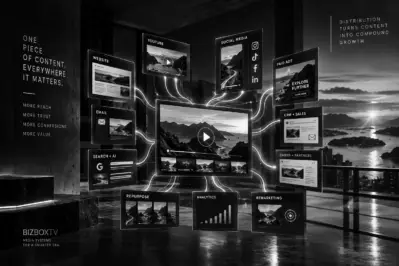
Now one piece of internal expertise becomes an expanding digital asset.
That is not a content calendar.
That is a Media System.
The Next SEO Advantage May Be Having Something Worth Saying
There will always be technical optimization.
Websites still need structure. Search engines still need to crawl pages. Keywords still help establish relevance.
But none of that solves the more fundamental problem:
What are you contributing that did not already exist?
That is the question I think businesses should be obsessing over as AI transforms search.
Not:
How do we produce 30 articles this month?
But:
What does our organization know that deserves to become part of the world’s information?
That question changes everything.
It changes who creates content.
It changes what gets filmed.
It changes how businesses use their employees.
It changes the relationship between PR, SEO, social media, video + advertising.
And it turns media from a marketing function into organizational infrastructure.
Every Company Is Becoming a Media Company
I have said some version of this – for decades.
But AI may finally make the statement impossible to ignore.
The businesses with the strongest information ecosystems will not simply have websites.
They will have libraries of expertise.
Articles.
Interviews.
Videos.
FAQs.
Research.
Customer questions.
Demonstrations.
Case studies.
Original photography.
Expert commentary.
Stories.
All interconnected.
All discoverable.
All reinforcing what the organization knows + why anyone should trust it.
That is the direction I believe search is heading.
And perhaps one of the most interesting consequences of artificial intelligence will be this:
The explosion of artificial content may make authentic source material more valuable than ever.
For businesses, that creates an enormous opportunity.
Do not just optimize your website to rank.
Build a business worth citing.